Sunday, August 5, 2012


Friday, July 6, 2012
Seirim are demons
Isaiah 13:21:
Mongooses will lay there, and their houses will be filled with ochim; benoth yaanah will dwell there, and seirim will dance there.Rashi:
"seirim" -- demons.
Israel compared to stars
Isaiah 13:14:
And you (Babylonia/Nebuchadnezzar) said, "I will ascend, over the stars of G-d I will raise my throne..."Rashi:
"the stars of G-d" -- Israel.
Sunday, December 25, 2011
Monkey Tales
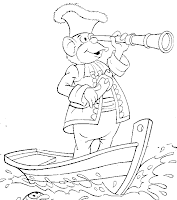
Everybody knows and loves that good old children's classic Caps for Sale. In this ironic tale, the protagonist, a cap salesman who has the peculiar habit of wearing his wares in a towering pile on his head, takes a nap beneath a tree. When he awakes, he finds his hats missing and discovers that a band of monkeys hanging about the tree above him have all adorned themselves with his caps. He coaxes them to return them to him with a wave of his finger, his fists, and with stamping feet, but his attempts are only met with the monkeys mirroring and mimicking his every move. Finally, he angrily throws his hat to the floor in disgusted defeat, and of course, the monkeys do the same, and the man has his hats back. Caps for Sale was published in 1938, yet, I discovered, its plot is based on a tale quite a bit older.
is are my own):
The Talmud (Megilah 3A) imparts the following wisdom (comments in parenthes
is are my own):
"Ravina said: ...If someone becomes frightened, even though he does not see (the source of his fright), his guardian angel does see it. (I.e. A person will become subconsciously aware of a spiritual danger although he cannot consciously detect it.) What can one do to rectify the situation? One should recite the Shema. (The recitation of the Shema has the ability to ward off spiritual dangers.) But if one is standing in a filthy place (not suitable for the recitation of the holy words of the Shema), one should leap four cubits from one's place. If one cannot [leap from one's place], one should say this: 'The goat at the slaughterhouse is fatter than me' (to ward off the spiritual attacker by directing it to a more tempting target)."
Rabbi Yoseph Chayim of Baghdad (a.k.a. Ben Ish Chay), in his classic commentary to the aggadic portions of the Talmud, Ben Yehoyada, explains:
"The reason [the sages of the Talmud] said one should leap, and did not say one should 'distance oneself' four cubits, is because they devised a wise [strategy] to save one from the demons (i.e. the spiritual predators) through leaping from one's place. It is known what our master, the Arizal, taught, that the entire desire of the evil inclination is to make itself appear similar to that which is holy, like a monkey vis-a-vis a man, that is, that the nature of a monkey is that it acts as the man who is before it. Therefore, the demons, who are rooted in the evil inclination, also have this nature of the monkey, to performs acts like the acts of men, in order to make themselves similar to them. Therefore, it seems that the guardian angel of this person who becomes frightened sees that there are demons standing there next to him, and if he would distance himself from that place via walking, [the demons] too would walk with him, so what good would distancing himself do? Therefore they gave him the advice to leap four cubits, for then his leaping would be great and strong according to his ability, for he would be compelled to leap with all his strength, and the demons, whose way is to mimic the action that the man performs before them, like the way of the monkey, would certainly also perform a great leaping with all their strength after seeing that this person strengthened himself to leap with all his might. Then the leaping of the demon, commensurate with its level of strength, would be to a very distant place, possibly several hours distant, for in accordance with the strength of the demon who leaps with all its strength, certainly its leaping will be a very great measure, and once it is uprooted (from its attachment to the person), it is uprooted (and will no longer follow the person). The result is that this man is separate and distant from them a great and awesome measure."
And here comes the kicker, as the Ben Yehoyada continues (emphasis added):
"And I heard people telling that a certain seaman did such a stratagem to monkeys that wore the hats that were spread out on the shore before the boat, and through such a stratagem he took all the hats that the monkeys had taken, since the nature of monkeys is to do that which the man before them does, for they desire to be similar to men."
And while Caps for Sale was published in 1938, the earliest edition of Ben Yehoyada of which I am aware was printed in 1904.
Monday, October 17, 2011
Deep Stuff
It is a basic tenet of Jewish belief upon which a Jew's spiritual eternity rests that Ha-Shem (G-d) has no form, physical or otherwise, that we may conceive. Because man is so immeasurably removed from the essence of Ha-Shem by virtue of man being a creation of Ha-Shem and therefore intrinsically and qualitatively distinct from Him, Ha-Shem's Infinity, therefore, lies impossibly beyond the realm of man's comprehension.
What is the meaning, then, that man is created "in the image of G-d"?
Rabbi Yishayah ha-Levi Horowitz, of blessed memory, in his magnum opus, Sheney Luchoth ha-Berith ("The Two Tablets of the Covenant"), writes in the section "Torah she-biKhthav" ("The Written Torah," a commentary on the Five Books of Moses), according to Kabbalistic tradition, that in creating the physical world, the process known as "Atziluth" or "Emanation" gave way to a substance heretofore nonexistent. However, this "substance" inasmuch as its existence straddled the boundary between existence and nonexistence, was so "spiritual" in nature, that is, as non-physical as possible, that its intangibility would be impossible for the human mind to conceive. Notwithstanding, the "hishtalsheluth" or "unfolding" of the world meant the crystallization of this substance into a final physical form, with all the intervening forms remaining intact and forming a sort of bridge between the Almighty, whose Infinity, again, totally transcends the existence of the universe, and the physical realm which we inhabit.
Now, inasmuch as this initial Creation was an Emanation from the Almighty, while we cannot grasp His form, for He has none, in any sense meant in human terms, we can contemplate the "form" of this initial Emanation, this first stage of existence. This initial Emanation is also termed "Adam," or "Man," and is the point of contact, as it were, between the created world and Ha-Shem. Therefore, this Emanation is sometimes termed the "Image" of Ha-Shem. This is the highest vision a prophet can see and is described as "the Man sitting upon the Throne."
The human being is the final end result of all the "unfolding" that begins at this interface between Ha-Shem and the universe and is seen as its final imprint. Therefore, the creation of Man is described as creation in the Image of G-d.
The purpose of this creation and of all creation is to make Ha-Shem known. For this reason the universe begins as an "imprint" of Ha-Shem and unfolds in this pattern until it reaches its final form as Man, the "image of G-d."
Just as Ha-Shem created a world and a creature reflective of Himself in order to increase awareness of Him, likewise, He desires that Man continue to this end, increasing the awareness of Him, through procreating in his own likeness that is the Likeness of the Creator. It follows then, that just as Ha-Shem's way is to create in His Likeness, then emulation of Ha-Shem is to create in one's likeness. Therefore, one who engages in procreation indeed takes on G-d's likeness while one who does not has not fulfilled the purpose of his own creation that is to be a G-d-like creature.
Wednesday, October 12, 2011
Be Fruitful and Multiply
"The reason for this commandment ('Be fruitful and multiply') is in order that the world be inhabited, for Ha-Shem (G-d), be He blessed, desires its inhabitance... This is a great commandment that is the cause of the fulfillment of all the other commandments in the world, for the Torah was given to mankind and not to the ministering angels. Therefore, [a man] must leave after him someone that will fulfill the Torah and the commandments and will recognize that there is an omnipotent watchful Creator, and [ensure] that this matter not cease to be among Israel. This is the intent of our Sages of blessed memory in that which they said, 'The principal offspring of the righteous is their good deeds.' This means that the principal intent of the righteous in siring [future] generations is to bring beings into existence that will fulfill the commandments and engage in good deeds."
-Rabbi Yeshayah ha-Levi Horowitz, Sheney Luchoth ha-Berith, "Torah she-biKhthav," B'Reshith
Subscribe to:
Comments (Atom)